Showing posts with label homeschooling. Show all posts

Friday, April 16, 2021

Learn and Play: The Stone Age


Learn about stone age people through fun imaginative play activities like a hunter gatherer hike, making play bows, arrows, and spears, making rock paintings, and more.  (Homeschooling, History, Ancient Times)

This post contains affiliate links through which I can earn commission...specifically to some suggested books sold through Amazon.

Would you like some fun activities to do with your children to help them learn about what life was like in per-historic times?   Here are some the things I did with my son to help him learn about the Stone Age.  


Suggested Books

First, we read the books below to build interest and learn more about what life was like in the Stone Age.   Both of these books are available at Waco Libraries, and  The First Dog is also available at the Hewitt Library. 

The First Dog Cover - shows picture of wolf

 The First Dog, by Jan Brett,  is a beautifully illustrated story about a boy and a wolf who befriended him, and became the first dog.   It's a wonderful piece of fiction to get kids interested in life in the stone age.   There are some great activities listed below to go with this, but I also found this  whole page of activities to use with The First Dog if you want to do more, or do something different.
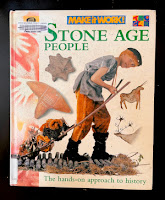


Book cover of Make It Work:  Stone Age People
Stone Age People is an excellent non-fiction book to explore more about this part of history.   Its part of the Make It Work series, which has a lot of crafts and projects kids can do related to the topic, as well as a lot of great historical information.  Everything is presented in the form of a model or presented by real kids dressed as ancient people.

My son was pretty young when we first read this, so I didn't read all the text.   We looked at the pictures and talked about what was happening and read some of the sections that told more about things he was interested in.   We spent a lot of time on the page below talking about what the people were doing.


This page of stone age people shows a hunter gatherer camp with various activities going on.


Activity:  Hunter Gatherer Hike

Materials:  

  • Straight branches (and something to cut them with)
  • Twine
  • Cardboard

For a follow-up activity we decided to do a "hunter gatherer" trek on the hiking trail behind the Carleen Bright Arboretum.   Any wild place would do though.

I made some really simple toy bows and arrows and spears.  SERIOUSLY SIMPLE.  Those are branches from our tree and some weed stalks (we have some really vigorous roadside weeds here in Waco...I suggest wild goldenrod if it lives near you). The string is just brown yarn, and the tips are cardboard.

The bows actually sort of  worked (they could shoot the "arrows" a few feet...not fast enough to hurt anyone, but far enough to be "cool."


Larger picture of arrow tip.
I attached the tips of the spears by splitting the top of the branches and inserting the cardboard ...then binding yarn around to make it tighter.  If I had thought better I would have cut a "shaft" on the tips and wrapped the yarn around that.  They might have stayed on longer that way....but they worked well enough.  We invited another family to go along, and the kids enjoyed using these.

I've seen some other bow versions that may shoot a little better made from bamboo or PVC (And I love the idea of an eraser capped arrows).   If you have older kids and want to try your hand at making a really realistic primitive arrow (with bone), there's a nice tutorial here

After making our arrows we headed for the nature trail.  We didn't know beforehand that the trail had been decorated with funny scarecrows for Halloween, so we ad-libbed and wondered out-loud who had made these strange statues, and what they might mean.

One of the kids found snails and we talked about how that would be great in our soup that night (No, we didn't really eat them...no wild escargot for us!).

We stopped for a break of seeds and berries my friend had brought (um..."gathered earlier"), and then hiked down to a small stream.  I had hoped to find animal prints near the muddy bank...we did find one dog print (um...I mean..."wolf" print), and lots of tiny fish we pretended to catch for supper.  AND, my friend found an edible plant, purslane, which we tried, with mixed reactions (her daughter hated it so much she drank her whole water bottle to wash away the taste away...but I liked it.  It sort of tastes like lettuce.). 


Purslane
Purslane

Be careful if you are trying any real "foraging."...do your research beforehand and only try things you're sure about.   Purslane actually has a poisonous doppelganger, spotted spurge, so make sure you study up on look alikes and know how to tell the difference before sampling.  There is a picture of purslane and it's poisonous look-alike at the bottom of this page on Foraging Texas, for comparison. 

Also, you want to make sure to wash anything well before you eat it (you can rinse with a water bottle), and avoid collecting anything where pesticides or herbicides might have been sprayed (our purslane was found well off the beaten path so should have been safe from those). 

Here's some other wild edibles you might find while hiking in Waco...


Blackberry


Blackberry is pretty easy to spot.  You want to only eat the dark black/purple berries.   The red ones, while they may look like raspberries, are way under-ripe.  


Dandelion

Dandelion was the first edible plant I tried.   You can eat the whole thing, from petals to root (though the root should be cooked or dried).  The leaves and petals have a peppery flavor and are something kids can try on the trail.   They are rather bitter though...so your child might not want to chomp on a whole flower. 

While dandelion has quite a few look-a-likes in Texas, all of them that I'm aware of are edible too.  There's a list at the bottom of this page


For learning more about edible plants in Texas I suggest browsing the Foraging Texas site.  


Activity:  Rock Art

Children's rock art project - for learning about ancient cave art and other  petroglyps 

Materials:
Rocks
Paint*
Pain Brushes*

(*You can also make your own paint and brushes...see notes below)

We did this rock art activity at my son's school years after our hike, but I thought it would fit well here.   You could even do this rock art using rocks and materials you find on your hike if you want to.   

The kids in my son's class were learning about the prehistoric artwork in the Lascaux caves.  Archeologists and historians call ancient rock are "petroglyphs." 

For a precursor to this activity can watch this video about the Lascausx Caves or this  shorter video about these caves here, or take a 365 degree virtual tour here (this interactive Pano on FB is also cool).  

First, I collected rocks to paint on.   Because of time we just used regular paint...but I tried to match the colors to those used in the Lascaux cave, and we talked about why they used those colors and what materials they would have made their colors with.   You can also make your own paint using minerals or gathered material, which would be really fun.  For older kids, this article has more about prehistoric paints, and they have some links toward the bottom to paint-making activities that look more at the chemistry of making paints.   You can also have kids make their own paint brushes using natural material like sticks, hair, leaves, or grass. 

Here's our rock art.   Our son really enjoyed this.


Cave art kids craft


Activity:  Make Your Own Cave Book
 
After learning hunter gatherers in the stone age, children may want to make a story of their own.   Here is a cave book my son made using  cave printable here (free to download). 


Cave art kids book

You can see he made hand-prints on the cave wall, like some of the cave art we had looked at, and a wolf like the story of the The First Dog (in this version the wolf had a pup).


MORE RESOURCES


If you are using Story of the World curriculum you can find info on these activities aligned to that curriculum on my other blog, Imaginative Homeschool.


Friday, May 3, 2019

Ancient Egypt and the Science of Making Mummies


In our homeschool we often combined history and science.  Here is a lesson, and experiement, we did about the Science of making mummies.   Even if you're not homeschooling this would make a fun summertime activity for kids.

For this lesson we used the unit study "Science of Ancient Egypt:  Mummification" (which was part of a larger bundle on Ancient Egypt by Dr. Dave's science which I bought after falling in love with his free sample unit on The Nile).   We had already read about mummification in various local library books about Egypt, but this covered some things that the other books didn't about the science involved in the process (like how microorganisms are involved in breaking down bodies, and how Natron, the salt mixture the Egyptians used in mummification, prevented these from growing by removing moisture).

While the Unit Study was labled for 4th - 7th graders, we did this when my son was a 1st grader with a Kindergarten sized attention span.   I felt like the material was engaging and kid friendly enough for him to handle even though it was meant for older kids...especially since he loves science.  (And I was right)

Some tweaking was involved though.  Because of his age I didn't try to cover the whole unit, since I knew that would be an attention span stretch.  In stead I  used a couple of pages from it for this lesson, and I did what I always do...added some tactiles and visuals, and of course, lots of questions. 

First, we reviewed Egyptian mummification with this video...


Then, before we dug into the text, I took my son outside to see something I knew had been sitting out by the fence in our yard...the remains of a dead bird.   I knew it would be a great example of what happens to an animal after it dies...and how microorganisms take part in that process (though I'm sure ants took a part too).


I pointed out the bones and the beak and the feather, and asked my son "What do you think happened to the rest of it, all the bird's muscles and stuff?"

He gave a guess about the bird going to heaven (theology lessons pop up when least expected, don't they?).

"Well, the Bible doesn't say whether birds go to Heaven.  Some people think they do, and some people don't, but we don't know.   But when people go to Heaven it says God gives us new bodies...so our old bodies stay here when we die.   So even if animals go to Heaven it doesn't mean their bodies do too.  So what do you think happened to the bird's body?"

I let him give a couple more guesses and then said, "Lets go inside and find out!"  That got him interested and he listened intently as I read the whole page in the unit study on "Preserving the Body,"  which talked about how microorganisms break up and consume dead things and how the mummification process prevents that.

At that my son expressed some fears about microorganisms eating him...so I told him about how when we're living that our cells have ways of fighting bad bacteria and germs, and that other bacteria lives in our body and doesn't hurt us.  But when someone or something dies than its cells die too, and so the microorganisms then start to eat the dead cells.

For older kids, you can find a more detailed answer to that question here.   The video below doesn't directly answer that question, but does describe the process of decomposition.   I don't suggest this very young children because some of the illustrations could be scary for them, but it would be great for most older kids.   After minute 2:27 it talks about the problem of burial space/cost and some solutions, and you can decide whether you want to share that or stop the video there, since that isn't really as relevant to the topic.


After reading the "Preserving the Body" section, we skipped the next page ("Salt) to come back to after we had done our egg experiment (as it gives away the end), and read the first paragraph of "The Chemistry of Salt."  This first paragraph talks about how salt is a mixture and how there are different kinds of salt (even baking soda is, chemically, a salt).  So, I showed him some.


Aw, the salt looks like a funny monster face.
Click on it to see the different salts enlarged.


We looked at regular salt, coarse ground sea salt, Himalayan sea salt, Epson salts, and baking soda.  I left these out on a dish for him touch and play with while I read the next paragraph about natron.  When we got to the last paragraph about where the Egyptians got natron (in the Natron Valley, in the Nile Delta), we looked it up on our map. 

MAP TIPS:   Most ancient Egyptian maps won't have the Natron Valley labeled.    It's located on the west side of the Nile Delta (the river area shaped like a V where the Nile meets the Mediterranean.   "Wadi El Natrun" is it's current name, which is actually Arabic (so, a later name).   In Coptic (the language descended from the ancient Egyptian language), it is called Šihēt, meaning "Measure of the Hearts."    (This may still be tied to it being a source of the natron used in mummification, since in ancient Egyptian religion, the heart was weighed before a person could enter the afterlife).  


Egg Mummy Experiment
After that we did an experiment where we mummified a hard boiled egg.  I've seen this done with apples too, or a whole chicken.    Several day into our experiment, we read the page on "Salt" that we had earlier skipped, after making guesses as to why our egg had shrunk and hardened.  

  1. Hard boil an egg (or two if you want to have a "control" egg...see section below).  Peel off the shell.
  2. Measure the egg with flexible tape ruler and write down results.  (Dr. Dave's science has a supplementary printable resource that has charts you can use to record and graph these, but it costs extra, and it would not be too hard to make your own chart.)
  3. Weigh egg and write down results.
  4. Mix an equal amount of salt and baking soda to make an approximation of natron (you can just use salt in stead)...enough to cover an egg.
  5. Put the egg in a cup or open container and cover completely with natron mixture.
  6. Uncover egg and repeat steps 1 - 3 every day for several weeks until the weight and size remains constant.

CONTROL EGG
We also put another egg outside in an open container to see what happened to it (but did not measure it, because I knew after a while we wouldn't want to touch that one).  In stead we took pictures.


Below are our pictures of our egg mummy (left) and control egg (right). OK, yes, that first picture is the same egg reversed...cause I didn't take a picture of the mummified one before we put it in the salt.  It's not consecutive days because we didn't take a picture every day (the days shown are as follows:  Day 1, Day 2, Day 5, Day 9, Day 12), and the sizes are not completely to scale, though I did try to show how they shrunk (it was a little more dramatic than the pictures here shows, actually).  But you can still get the general idea.

Click to see larger pictures.


(We missed taking a picture of the mummified egg that last day shown, but I thought the changes in the other egg were interesting).   The control egg eventually withered away to nearly nothing and we tossed it.  The mummified egg eventually turned rock hard and gray, but alas I didn't take a final pic. I left it outside and then forgot about it a long time and it was gone (guess it didn't stay forever, but we live in a humid area, not the dry Egyptian desert).  Plus, some animal may have eaten it. 

This was a fun lesson and my son really enjoyed it.  I would recommend this experiment for any kids interested in mummies.    


More Mummy Activities
We didn't do the following, but any of them they would make a fun addition to this study.


Mummify a Chicken (In case an egg mummy just wasn't enough...)


Read more of my history posts at...


~ ~ ~


Friday, August 3, 2018

Inner Space Cave Unit


 I'm in no way affiliated with Inner Space Caverns.  
These pages may include Amazon affiliate links which can earn me commission.

4 years ago we took an amazing trip to Inner Space Caverns.   It was not long before my youngest son's first year of homeschooling, and it sparked a desire to learn more.

Using the One Small Square - Cave book that I found at our local library as a spine, we did an in depth unit on caves that, looking back, is one of the highlights of our homeschool experience.  

I've written up a 13-15 day Unit Study on Caves for others to use too (see links below).  It includes the activities that we did, along with others I've found that also look fun for various ages of kids.   This is a "choose your own activity" adventure.   You choose which activities are right for your children.   It is however designed with the idea that you will actually visit a cave (and has some activities aimed specifically at visiting Inner Space, since it's the nearest large cave to Waco).   If you're not visiting a cave, or are visiting a different cave, that's ok---it shouldn't be too hard to tweak this to fit your needs.

While we did our unit AFTER visiting Inner Space Caverns, I re-designed this unit to come before a cave visit (since the Cave book we used has lots of ideas that to actually do IN a cave. )  But,  of course, visiting a cave first would spark interest, and you can absolutely do it that way too (it's what we did, after all).  If you do a cave visit first I suggest skipping ahead to Day 13 - Inner Space Visit which has some suggested activities for the day before, during the visit, and after the visit.   Of course, if you can afford multiple cave trips, there are other nearby caves you can visit, and there is also the Natural Bridge Caverns in San Antonio (which I've heard are amazing) which you could visit before, after, or during the unit.    And there's even a "faux cave" in the Mayborn Museum that would make an easy side trip during your study.


MAIN TEXT USED

One Small Square - Cave by Donald Silver is beautifully written and illustrated, and rich with information--a true living science book.   Like all of his "One Small Square" books it takes you into an environment (this time a cave), and asks you to explore "one small square" of it in great depth.  The sections are short enough to hold the short attention span of my 7 year old, but deep enough to make a real science study using this book as the spine even for older kids.    There are fun experiments and activities in sidebars throughout.   Unfortunately, it is not longer available through Waco Libraries, but you can buy it on Amazon or various other booksellers.   


ALTERNATE  FREE TEXT

You CAN use this study without buying the book above by in stead using the Junior Cave Scientist Workbook that is free through the Forest Service.   While it lacks some of the info in Donald Silver's book, it still has enough to create a fun caves study around.   I've put together a guide on how to combine the suggested extra activities in my Unit Study with that  Workbook as an alternative spine (main text):   Alternate Workbook Guide.


CAVE UNIT STUDY

The reading schedule and discussion questions are also contained in a printable Discussion/Reading Guide PDF (which does not include the activities, videos, book suggestions, ect....just what pages to read daily from the Donald Silver Caves book, and the discussion questions with them).


(NOTE:  While usually blog posts here go from newest to oldest, since I posted this all at once I posted it in order).  


Linked Up at Throwback Thursday and Homeschool Highlights

Thursday, April 6, 2017

Fixer Upper Teacher Pay Teacher Set

Hey, look what I found on Teachers Pay Teachers....


Just kidding...or at least, the seller Lita Lita was just kidding.  This was an April Fools joke (a brilliant one, I might add).  No, there wasn't actually a resource that had kids learning about shiplap and estimating budgets with cheery Chip and Joanna Gains graphics (but hmmm....should there be?  *grin*).

Actually, I got curious and after searching TPT I did find a REAL math resource with a Fixer Upper theme (for 6th - 8th graders), and I also found several classroom decor resources inspired by the show and a bunch more by searching shiplap.  Ha!


___________

Shared on Throwback Thursday

Saturday, September 10, 2016

Fall Homeschool Events In Texas

Below is a list of Homeschool Days and and other fun special events and discounts for homeschoolers in Texas (the ones I know about).  May also include some "mid-school day" events not especially for homeschoolers.    Events in or around Waco are in bold.  Ones a little further but still in driving distance (1-3 hours away) have an orange star* next to them.


SEPTEMBER


LegoLand - Grapevine, TX*
Homeschool Week September 12-16th - Includes a LEGO® Education Workshop. Tickets will be $10 per day plus tax for both children and adults. Reservation Required

Sea Life Aquarium - Grapevine, TX*
Homeschool Week September 12-16th - Each ticket will include entry to the SEA LIFE Grapevine and a special Amazing Discoveries educational scavenger hunt. Complete the scavenger hunt and receive a SEA LIFE Guidebook to continue the fun at home.  Tickets $10.  Reservation required.

Austin Zoo*
Sept 23.   Science, technology, engineering, art, and mathematics activities for homeschool families including activities from partner organizations, keeper talks, and a special education animal presentations!

Houston Zoo*
Sept 15, 10:00am – 1:15pm.  Eco Experiments - A day of science fun and experimental engagement where students will take part in hands-on investigations and deepen their understanding of scientific processes. Registration includes access to hands on experiments, 3 exclusive animal encounters, and general admission to the Houston Zoo.  $30 (or $20 for members).


OCTOBER

Houston Zoo - OFF SITE, Texas City
Oct 5, 9:30 - 1:30 PM.  Field Researchers Day is an interactive event which allows students a first hand feel of a day in the life of a field researcher.  We will use field testing techniques to determine the health of an endangered coastal prairie ecosystem.   Registration includes exclusive access to the Texas City Prairie Preserve where you will be accompanied by Zoo staff.  General admission to the Houston Zoo is covered in the price, however all activities are held in Texas City.  $30 (or $20 for members).

Skate Country - Bellmead
October 6, from 2-4pm. Homeschool skate is a private party event for Waco area homeschoolers! Location - Skate Country in Bellmead 500 Texas Loop 340, Bellmead, TX 76705 Cost of Skating - $5  Children's playground (for children under 7) - $3

Space Center Houston
Oct 5    Oct 5th from 4:30 - 9:25
Space After Dark Program includes
• Live briefing about Mars.
• Dinner served at Space Center Houston.
• Exciting, grade-level appropriate, hands-on activities.
• Private guided tram-tour to NASA Johnson Space Center.
• Second-day admission to Home School Day 2016.

Space Center Houston
Oct 6.  Homeschool Day. Meet retired NASA astronaut Mark Polansky and hear from NASA Johnson Space Center experts on a variety of topics including the Cassini Mission to Saturn and NASA inventions that have improved the lives of ordinary people. Engage yourself with Sphero and Vex Robotics Challenges. Get hands-on in our interactive Pop-Up Science Labs where you can see demonstrations of Newton’s Third Law of Motion, make a small bulb light up, discover the destructive force of meteors and so much more!

The Game Closet - Waco
Oct 18 - 1-4 pm.   Play various board games.   Over 100 games to choose from.


NOVEMBER

Texas Renaisance Festival* - Todd Mission TX (2 Hr from Waco)
Nov 1-2, 8 am - 4 pm.   Day for educators, students, and homeschoolers only, with reduced price of $9.  Students step back in time as they enter the sights and sounds of New Market Village, an authentic recreation of a 16th century European village. Students will interact with hundreds of costumed characters representing the courts, culture, art, science, and literature of the Renaissance Period.

Houston Zoo*
Nov 8, 10:00am – 1:15pm. Scavenger Hunt Safari Day includes stations set up around the Zoo to provide students opportunities to connect with animals and create meaningful memories.  Registration includes access to the scavenger hunt, 3 exclusive animal encounters, and general admission to the Houston Zoo. $30 (or $20 for members).


WEEKLY/MONTHLY/ANYTIME

Hill Country Science Mill  - Johnson City*
Monthly - 2nd Wed each Month.   In addition to museum exhibits, there will be  special demonstrations, activities and/or guests.  Children $6.  One parent/educator free with attending children. $4 - 6 extra for Learning Labs. 

Dr. Pepper Star Center  - Farmers Branch*
Various Times/Days.  Ice Skating Homeschool Skate Days happen on a regular basis.  Please call the Group Event Coordinator (Brittany) at 214-432-3131, ext. 227 for information on day, times and cost.

Sea World - San Antonio*.
Home School Days programs are available on select non-operating dates in November and December - reservation required.   This guided program includes family-focused, appropriate, and interactive experiences centered around animal adaptations and educational activities throughout the park. Students will explore and learn about animals, conservation efforts and stories relating to SeaWorld. $18 per participate (including supervising adults...children 2 and under are free).  Admission to SeaWorld is not included and is not required.   Reservartions must be made 14 days in advance. 


Also try these sites...
(Some may be for previous years)
Homeschool Days and Field Trips in Dallas


If you know of any other events, please, please share them in the comments below and I'll add them to this list. 


Saturday, September 12, 2015

Shipwrecks and Pirates

Pirate Pic from Graphics Fairy

If you haven't been to see the Shipwreck Exhibit at the Mayborn,you still have until September 16th to take it in (alas...by "Talk Like a Pirate Day it will be gone."    If this exhibit has sparked an interest in pirates, sailing, shipwrecks and the like, here are some free resources you can use to incorporate this into homeschool or do some afterschool research on the subject.

MULTI-SUBJECT or MISC

History of Navigation Video

How Pirates Navigated - And a List of Pirate Resources

Editable Pirate Game (All Ages)

Pirate Coloring Pages and Printable


HISTORY

Webpage on How Columbus and Apollo Spacecraft Navigated
 
Titanic Shipwreck(KG, 1st, 2nd, 3rd)


MATH

Pirate Math Printables (PreK)

Pirate Themed Number/Word Match (PreK) 

Pirate Measurement (KG, 1st)

Pirate Place Value (1st, 2nd, 3rd)

Pirate Cut and Glue Math (2nd)

Pirate Multiplication Color By Number (2nd, 3rd,4th, 5th)

Pirate Themed Word Problems (3rd,4th)

Pirate Geometry (3rd,4th, 5th)

How Math Is Used in Navigation - Video (Middle/High School)


LANGUAGE ARTS

Pirate Questions (All Ages)

On the Deep Blue Sea - Emergent Reader Book (PreK, KG, 1st)

Master of the Ship - Sight Words, Alphabet Game (PreK, KG, 1st)

Sailing Into Summer Journaling Pages and Craftivity (KG, 1st, 2nd, 3rd)

Shipwrecked Pirates(KG, 1st, 2nd, 3rd, 4th)
An activity for using descriptive language.

Talk Like a Pirate - Context Clues Game (3rd,4th, 5th)

Pirate Research Project (5th, 6th, 7th, 8th)


SCIENCE

Rubber Ducky Ocean Currents  (4th, 5th, 6th, 7th)


SPEECH

Pirate ARRR-ticulation (1st, 2nd, 3rd, 4th, 5th)


Wednesday, April 29, 2015

Homeschool Giveaway Link-up

This is an ongoing link up for Homeschool giveaways.  This link up is ONLY for giveaways related to homeschooling, for items such as....
  • Homeschool curriculum
  • Educational Toys (Ok, pretty much ANY toy)
  • Kids books
  • Parenting or Homeschooling Books
  • Art Supplies
  • Printers or Printing Supplies
  • Educational Subscription Boxes
  • Educational Programs/Kids Camps
PLEASE ADD  AN END DATE TO YOUR TITLE!!!!!
If you have space please also put what countries your giveaway is open too.


Monday, November 17, 2014

Hunger Games Trilogy: Review and Related Homeschooling Activities


Just finished reading the last of the Hunger Games Trilogy. And wow.   Wanted to share some of my random thoughts with you, and for those who are homeschooling teens/pre-teens, some ideas for activities and questions to have your children discuss/write about.

(Short disclaimer before I go on...the books pictured at the right are a Amazon affiliate link, through which I can earn commissions.   Legally, I gotta put that up near the top if I use Amazon for a easy picture cause I'm too lazy to find all three of our books and take a picture of them.   Now, moving on....)
RANDOM THOUGH 1
The last chapters of this book left me drained and sort of in a fog, and I think that was intentional. These are stories that will be with me for a while.
RANDOM THOUGH 2
I thought this with the first one but think it again. This is destined to be a classic...destined to be taught in school, like Fahrenheit 451 and Lord of the Flies. And it should be.
RANDOM THOUGH 3
I questioned again whether my oldest (age 11) was ready for these. The violence is...well, pretty severe. Not necessarily worse than the first, but well...more of it. But, he's already read the first (he found it before I had read it and was half way through before I realized it, so in stead of ripping him away half way through I thought the best thing was to read it as quickly as I could once he was done and talk with him about it). So I'm keeping with that tack, only this time I have the head start. I've already handed off Catching Fire to him. And, truth be told, I'm glad it happened that way, because he's going to see violence--it's in so many movies, a lot of TV, video games, etc. I can't keep him from it forever, and though I try to shield them from the worst of it I haven't tried to make a bubble around him. And I would rather have him see it presented like this, not glorified. Plugged In Online put it well in their review of the movie (and it applies to the book too): "We feel the violence viscerally and personally, and we're supposed to be repelled by it, not enamored with it." These books show the aftermath of violence in a way that is never trivial.   They explore the consequences of it not just to the victims but to the perpetrators and the families and society in general.    So I'm thankful he's getting this viewpoint to balance the other portrayals he'll see.
RANDOM THOUGH 3
ROME is Oh so present in these books. Having studied the Roman empire before, I can see it echoed in so many ways here (more on that in my discussion ideas!).
RANDOM THOUGH 4
God is noticeably absent: not only in the main characters, but anywhere, in any form. Any religion that is. No one prays, no one calls out to God or even curses him. I just think it's interesting. It even makes sense considering the story line (in a society where dissent of any kind is so repressed, the religious may well have been the first to be "removed.") But I do think that it's ironic seeing how the references to Rome and the "Circuses" where so many Christians died in horrible ways, is also so tangible here.
RANDOM THOUGH 5
It didn't come to me immediately, but in the last part of this book I see a lot of echoes of Lord of the Rings, even thought these books are OH SO DIFFERENT. Hunger Games is steeped in realism, in spite of the sci-fi aspects, and the strange mutant monstrosities that frankly have felt out of place in that realism (my only criticism of the books...while the subtle mutations--the mockingjays and tracker-jackets fit, the stranger "mutts" like the people faced wolfs and the giant walking lizards seemed a bit too cartoonish for the rest of this story). In contrast, Lord of the Rings has it's realistic touches, but is a fantasy adventure at heart--more the kind to inspire people to fight than to show them what fighting is really like. But Tolkien knew about war, and the reality of that war peeked through. Where the two stories are most alike is in the end, the aftermath, the denouement after the fighting has ceased--where the internal war continues. Both leave on a note that is sad...tragic in a sense, but not in the way that a Shakespeare play is tragic. It elicits more of an ache than tears, but is tinged with hope. And it leaves you with a better understanding and appreciation for the men and women who come home from fighting.


HOMESCHOOL/DISCUSSION IDEAS
This is a book series that it is just too easy to think of Essay/Discussion questions.  Below are a list of the ones I thought of.  When ideas are for a specific book in the series (not the trilogy as a whole), I've marked them with that.  
DURING READING:  
Honestly, these are the kind of books that I don't think you want to hamper too much with mid-book activities, because once you start you'll want to get to the end.  But the characters and places in it can be confusing to some, so these activities might help readers keep them straight.

  • Draw a character chart to help you keep track of the characters.  Write down what you know about them on the side.   (You can add details and new characters after every chapter).
  • Make a chart of the 12 districts and the capital, and write down information you learn about each district as you read (or at the end of each chapter).

HISTORY/SOCIAL STUDIES: 
Here are some activities for connecting the Hunger Games with lessons on history and social studies.

Compare and contrast any of the following:

  1. "The Capitol" and "Rome,"
  2.  "Bread and Circuses" in Panem vs. in actual Rome
  3. The gladiatorial Game in Rome to The Hunger Games (and their purposes)
  4. (MOCKINGBIRD) Compare the Government of Panem to Other Governmental Systems (Feudalism, Republics, Imperialism, etc) or Compare the governments of Panem and District 13.
  5. (MOCKINGBIRD:)  Compare propaganda from The Hunger Games, both that by the Capitol and by District 13,  to propaganda from history (US, Soviet Union, Nazi Germany, etc.).  
Other Questions Related to History...

  • Do you see any relation in Panem to American Society today?  How it it the same/how is it different?
  • The people of the Districts are described as "Slaves" at one point.  Do you think this description is accurate?    How does it compare to other forms of slavery you know of (both in the past and present day slavery/ie Human trafficking).  
  •  Describe how fashion is used in the book?  How does this differ from the way you've seen fashion portrayed in other stories you've read.   How has fashion been used politically in history?  
  •  Compare and contrast the rebellion in the Hunger Games Trilogy to actual rebellions in history.

LITERARY & READER RESPONSE
  • Why do you think the author used 1st person for this story.   How would it have changed the story if this had not been presented in first person.
  • Talk about how any of the main characters (Katniss, Peeta, Gale) changed over the course of the three novels.
  • Talk about how Gale and Peeta are literary foils.
  • How does Collin's portrayal of violence differ from portrayals of violence you've seen on movies or other books?
  • What was the main idea you think Collins was trying to convey in these stories?
  • (Best saved for Mockingbird, but can be used for any of the books) Which character did YOUR feelings about change towards most in the books?  Why?
  • How were the games portrayed?  How had Katniss' perception of things changed? 
  • (CATCHING FIRE)  How was the feel of the prep for the Hunger Games different in this novel than the first?  How were the tributes portrayed differently?  
  • (MOCKINGBIRD)  Who do you think sent the exploding parachutes at the end and why?
  • What character in the book are you the most like and why?
  • Why do you think the author did include any mention of God or portrayal of religion in these books?  Do you think this made the story more or less realistic?  How would the story have changed if religion was present?  (Possible study of the author's interviews or biographies related to this).


BOOKS/LITERATURE FOR COMPARISON/CONTRAST
  • Fahrenheit 451, or any other dystopian Novel:  Compare/contrast the "Dystopias."   What events from their own time (real life) might the authors  have been commenting on? 
  • Lord of the Flies:  
    • 1: Both The Hunger Games and Lord of the Flies deal with groups of young people put in survival situations, and how it changes them.    Why do you think both authors used youth in stead of adults in their stories?
    • 2:  The circumstances of both the Hunger Games and Lord of the Flies result in children/teens killing each other, but the circumstances are very different.  In one the children are left alone, in the other they are very much being controlled.  What does this say about the author's message?  How does it change the things readers take away from the story?. 
  • A Day in the Life of Ivan Ivonovich:  Compare/Contrast the Soviet Gulags to the Hunger Games as a means of controlling people.   
  • All Quiet on the Western Front:  Compare/Contrast portrayal of war.    Talk about differences being a Sci-Fi or Historical Fiction makes to the portrayal.
  • Lord of the Rings:  
    • Compare the authors portrayals of any  warfare or the aftermath of warfare.
    • Compare use of Sci-Fi vs Fantasy
    • Research the author's and talk about how the author's lives/experiences shaped their writing
  • (For MOCKINGBIRD, Specifically) Read Poetry by War Poet (such as those listed at the following link) and talk about how it relates to the descriptions of war in the Mockingbird.  (http://en.wikipedia.org/wiki/War_poet)

TV SHOWS TO COMPARE
While I'm not necessarily suggesting any of these for kids or teens, especially without parental pre-view,  I think all are good for compare/contrast with this book, especially where it deals with talking about Government control, warfare, dystopian stories, etc.,  All contain violence, most contain some sex.

  • Man in the High Castle - This show is a alternate historical fiction with a sci-fi aspect.   I thought it would be especially good for comparing portrayals totalitarian government, propaganda, and ethical questions regarding rebellion.  (Lots of violence, some sex, but still a worthwhile show I would let my teen watch).
  • The  100  (Especially good for comparison between the "Sky" society and District 13.   Contains sex and lots of violence and not a lot of people you'd want your teen emulating, so it's not one I'd actually let my teen watch, but dang, if they already have watched it, the comparison of worlds is ripe for discussion.)
  • Continuum  (Basically nature of war, and also propaganda - not as gratuitous on the Sex as "The 100" but it's present.   Violence is pretty bad too.   I would however encourage my older teens to watch this one.)
  • The Colony  (TV Show, not the movie)-  It's a reality TV show, exploring what would happen in a worldwide pandemic.  There's the whole nature of comparing a voluntary reality TV show about survival that's  definately ripe for discussion.  No sex, save some people stripping down to some pretty modest underwhere at one point.  And, put on by Discovery channel at least it had a better goal than just simply entertainment.


CREATIVE & OTHER:
  • Write your own story based on these books.  It can be a story that happened to the characters after these novels end, any of the scenes from this story written from another perspective (from Peeta's, Gale's, Prim's, Snow's, one of the other Tributes, etc.)
  • Draw a picture of any scene during the book you felt particularly moved by.
  • Remake any of the others Tribute's costumes as you think Cinna would have made them had he been THEIR stylist.  Explain your reasoning.
  • Write a poem in response to the book.
  • Put music to any of the songs in the book.
  • Put music to any of the songs in the book.
  • Make a map of Panem based on things you know about it from the books.    


PRINTABLES AND OTHER RESOURCES


Hunger Games Lessons Blog (Yes, there's a whole blog about just this)

And more...


This page is linked up at...
Throwback Thursday